
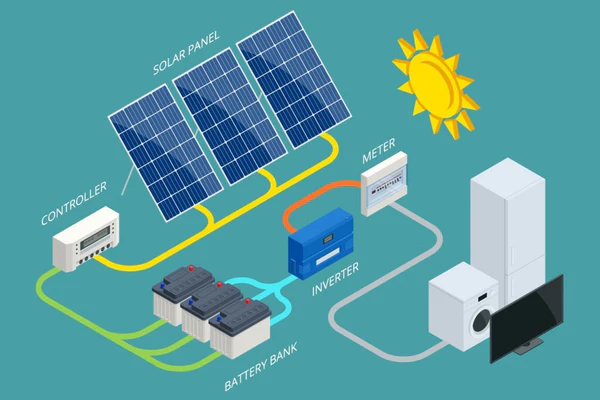
Com calcular la capacitat de la bateria solar? 3 Passos per a la mida perfecta
(A Practical Guide for African Homes and Businesses, with a Focus on South Africa)
Matching Solar Battery Capacity to Load-Shedding Schedules in Africa
In regions like South Africa and other parts of Africa, frequent power outages and unreliable grid electricity make solar energy systems a lifeline for homes and businesses. A critical component of any solar setup is the battery, which stores energy for use when the sun isn’t shining. No obstant això, choosing the wrong battery capacity can lead to wasted money, insufficient power, or shortened battery life.
This guide breaks down the process of calculating solar battery capacity into three simple steps, tailored to Africa’s unique energy needs, climate, and solar potential.

Pas 1: Determine Your Daily Energy Consumption
Before sizing your battery, you need to knowhow much energy your household or business uses daily.
- List all electrical appliances you plan to power with solar.
- Typical appliances in African households: Llums LED (5–10W), neveres (100–200W), Televisors (50–100W), aficionats (50W), mobile chargers (10W), and small water pumps (200–500W).
- Per a empreses: Computers, encaminadors, security cameras, or machinery.
- Calculate daily energy use (in watt-hours, Wh):
- Poder (W) × Hours of use per day = Daily energy per appliance.
- Exemple:
- 5 Llums LED (10W cadascun) × 6 hours = 300 Wh
- Nevera (150W) × 24 hores (cycles on/off) ≈ 900 Wh
- TV (80W) × 4 hours = 320 Wh
- Total daily energy = 300 + 900 + 320 = 1,520 Wh (1.52 kWh)
- Factor in inefficiencies:
- Solar systems lose energy due to inverter inefficiency (~10–20%) and battery charging/discharging losses (~10–15%).
- Multiply total daily energy by1.3 (30% buffer):
- 1.52 kWh × 1.3 = ~2 kWh per day.
Pas 2: Calculate Battery Capacity Based on Autonomy Days
Battery capacity depends onhow many days you need backup power (autonomy days). In South Africa, where load-shedding is common, 2–3 days of autonomy is practical.
1.Fórmula:
Capacitat de la bateria(kWh)=Daily Energy(kWh)×Autonomy Days
- Exemple: Per 2 days of autonomy:
2 kWh/day×2 days=4 kWh
2.Convert kWh to Amp-Hours (Ah):
- Batteries are rated in Ah at a specific voltage (p. ex., 12V, 24V, 48V).
- Fórmula:

- Exemple: For a 48V system:

3.Factor in Depth of Discharge (DoD):
- Most batteries (p. ex., ions de liti) should not discharge below 80–90% DoD. Lead-acid batteries are limited to 50% DoD.
- Adjust capacity:

- Exemple: Per a ions de liti (90% DoD):

Pas 3: Match Battery Capacity to Solar Panel Output
Your battery must align with your solar panel array’s charging capability.
- Check daily solar generation:
- South Africa averages4–6 peak sun hours daily (varies by season).
- Fórmula:Solar Panel Output(Wh)=Panel Wattage×Sun HoursSolar Panel Output(Wh)=Panel Wattage×Sun Hours
- Exemple: 400W panels × 5 sun hours = 2,000 Wh (2 kWh).
- Ensure panels can recharge the battery:
- Daily solar generation should exceed daily energy use.
- Exemple: If you use 2 kWh/day and generate 2 kWh/dia, you’ll need extra capacity for cloudy days.
- Account for system expansion:
- Add 20–30% extra battery capacity for future needs (p. ex., adding appliances).
Key Considerations for African Users
- Tipus de bateria:
- Ió de liti: Vida útil més llarga (10+ anys), higher DoD (90%), but costly.
- Plom-àcid: Cheaper but shorter lifespan (3–5 anys) and lower DoD (50%).
- Temperatura:
- Temperatures elevades (common in Africa) reduce battery efficiency. Instal·leu les piles a l'ombra, zones ventilades.
- Suport local:
- Choose brands with service centers in your region (p. ex., Huawei, Victron Energy, or local suppliers).
Example Calculation for a South African Household
- Appliances: 10 llums (100W total), nevera (150W), TV (80W), ventilador (50W).
- Daily energy: 1.5 kWh + 30% buffer = 1.95 kWh.
- Autonomy: 2 days → 3.9 kWh.
- Battery voltage: 48V → 3.9 kWh × 1,000 / 48V = 81.25 Ah.
- Ió de liti (90% DoD): 81.25 Ah / 0.9 ≈ 90 Ah.
- Bateria recomanada: 100 Ah lithium-ion (48V).
Consells finals
- Use a solar calculator tool for precision.
- Consult local installers to validate your design.
- Prioritize energy-efficient appliances to reduce battery size and cost.
By following these steps, you’ll ensure your solar battery system meets your needs, survives load-shedding, and withstands Africa’s climate. 🌞🔋
Lectura addicional:
- [La guia definitiva per a la bateria de liti de 48V 100Ah muntada a la paret: Responent 5 Preguntes freqüents clau]
- [48Bateria solar V 200 Ah Uganda: Resoldre les interrupcions & Estalvieu costos]
10Bateries kWh LiFePO4 10Costos de la bateria solar de kWh a Myanmar 25Sistemes de bateria kWh Tot en Un Contenidor BESS 4MWh Saudi Fabricant BESS Xina La bateria domèstica més barata Xina BESS Solutions Xina DDP a l'engròs Xina Factory LiFePO4 bateries Xina Grid-Scale BESS Proveïdors d'OEM xinesos Emmagatzematge comercial de bateries Kenya Solucions DC ESS Solució DDP directa a la RDC Dirigir la Xina a l'Àfrica Bateria directa de Xina a Àfrica bateria d'emmagatzematge d'energia Sistemes d'emmagatzematge d'energia Líders mundials de bateries de liti Bateria de grau A Proveïdor d'emmagatzematge de bateries a escala de xarxa Bateries domèstiques per a famílies holandeses emmagatzematge d'energia a la llar Industrial BESS Kenya Plom-àcid vs. Bateries de ions de liti LiFePO4 Bateries LiFePO4 Bateries LiFePO4 a Sud-àfrica Bateria LifePo4 Tecnologia de bateria LifePO4 Distribuïdor LiFePO4 a l'Iraq LiFePO4 ESS Kenya Bateria de ions de liti bateria de ions de liti Preus més baixos Tendències del mercat Armari de refrigeració líquida exterior Adquisició Saudita LiFePO4 Solucions BESS escalables per a la indústria Plaques solars sistema solar Apilament de tot en un Venda a l'engròs de bateries solars LiFePO4 Bateries solars a l'engròs
Un comentari