
7 Powerful Facts About Depth of Discharge (Ministère de la Défense) You Must Know
Profondeur de décharge (Ministère de la Défense): What It Means and Why It Matters for Battery Life
When it comes to battery performance and longevity, one of the most important—yet often misunderstood—metrics is Profondeur de décharge (Ministère de la Défense). Whether you’re managing a solar energy system, using lithium-ion batteries for home storage, or simply trying to maximize your battery lifespan, understanding DoD is crucial.
Dans cet article, we’ll explore what DoD means, how it’s calculated, and how it directly impacts Cycle de vie, especially for LiFePO4 (Phosphate de fer et de lithium) piles. We’ll also demystify the 20/80 rule, and clarify the difference between Ministère de la Défense et State of Charge (SoC).
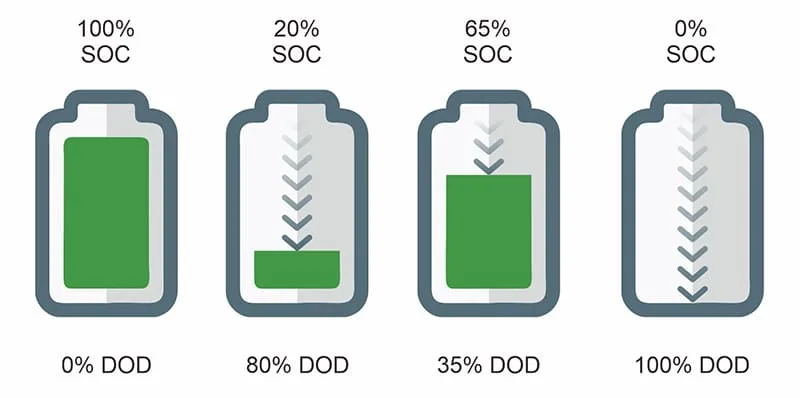
🔋 What Is Depth of Discharge (Ministère de la Défense)?
Profondeur de décharge refers to the percentage of a battery’s total capacity that has been used. Par exemple, if a 100Ah battery has discharged 80Ah, its DoD is 80%.
💡 Formula:
Profondeur de décharge (%) = (Energy Discharged / Total Battery Capacity) × 100
🔁 Depth of Discharge vs Cycle Life
One of the most critical relationships in battery usage is between Ministère de la Défense et Cycle de vie (the number of charge-discharge cycles a battery can undergo before its capacity drops below a usable level).
📊 General Trend:
| Profondeur de décharge | Environ. Cycle de vie (Li-ion) |
|---|---|
| 100% Ministère de la Défense | ~500 cycles |
| 80% Ministère de la Défense | ~800–1,000 cycles |
| 50% Ministère de la Défense | ~1,200–2,000 cycles |
| 20% Ministère de la Défense | ~3,000+ cycles |
Aperçu clé: The shallower the depth of discharge, the longer the battery lasts.

⚖️ Depth of Discharge vs State of Charge (SoC)
These two terms are often confused:
- Profondeur de décharge (Ministère de la Défense): How much of the battery is used.
- State of Charge (SoC): How much charge is remaining.
They are complementary:
Ministère de la Défense (%) = 100 – SoC (%)
Par exemple, if your battery has 30% SoC, it has a 70% Ministère de la Défense.
✅ What Is 80% Profondeur de décharge?
An 80% Ministère de la Défense means you have used 80% of the battery’s capacity and left 20% in reserve. For many lithium-ion batteries, operating at around 80% DoD is a common practice to balance usable capacity and cycle life.
⚙️ The 20/80 Rule for Battery Life
This widely recommended rule of thumb suggests keeping your battery charge between 20% et 80%, which means:
- Never let it fall below 20% SoC (80% Ministère de la Défense).
- Don’t regularly charge it to 100%.
This practice can significantly increase battery longevity, particularly in lithium-ion chemistries.
🔬 Depth of Discharge in LiFePO4 Batteries
LiFePO4 batteries are especially known for their high cycle life even at higher DoDs.
| Ministère de la Défense (%) | Environ. Cycle de vie (LiFePO4) |
|---|---|
| 100% | 2,000–4,000 cycles |
| 80% | 3,000–5 000 cycles |
| 50% | 5,000+ cycles |
Compared to other lithium-ion chemistries, LiFePO4 offers superior stability and longevity even when discharged deeply, making it ideal for solar energy storage and off-grid applications.
📈 Why Depth of Discharge Matters
Understanding and managing DoD allows users to:
- Maximize battery life
- Optimize return on investment
- Prevent over-discharge damage
- Improve energy efficiency in off-grid or hybrid systems
⚡ Final Thoughts
Whether you’re investing in a home solar energy system or deploying industrial-grade storage solutions, managing Depth of Discharge is key to maximizing performance and lifespan.
By keeping DoD within optimal ranges—especially with robust batteries like LiFePO4—you not only extend battery life but also protect your investment in renewable energy solutions.
Interested in high-quality LiFePO4 batteries designed for long life and high performance?
Contact us today to learn more about our range of advanced energy storage solutions.
5kWh 5Batterie de secours kWh pour la maison 10Batteries LiFePO4 kWh 16Solutions kWh LiFePO4 pour les partenaires grossistes Tout-en-un Conteneur BESS 4MWh Saoudien Fabricant BESS Chine Batterie domestique la moins chère Solutions BESS en Chine Batteries LiFePO4 d'usine de Chine BESS à l’échelle du réseau chinois Stockage de batteries commerciales au Kenya Solutions DC ESS Solution DDP directement en RDC Diriger la Chine vers l’Afrique Batterie directe de la Chine vers l’Afrique Entrepôt à l’étranger de la RD Congo batterie de stockage d'énergie Systèmes de stockage d'énergie Batterie de qualité A Fournisseur de stockage de batterie à l’échelle du réseau Batteries domestiques pour les familles néerlandaises stockage d'énergie domestique Industriel BESS Kenya Piles LiFePO4 Batteries LiFePO4 en Afrique du Sud Batterie LifePo4 Fabricants de batteries LiFePO4 Technologie de batterie LifePO4 LiFePO4 ESS Kenya Batterie lithium-ion Batterie aux ions lithium Des prix plus bas Prix le plus bas Ouganda Tendances du marché Batteries solaires hors réseau pour les foyers européens Armoire de refroidissement liquide extérieure Révolutionnez la puissance commerciale avec BESS personnalisable Achats saoudiens de LiFePO4 Solutions BESS évolutives pour l’industrie Panneau solaire système solaire Empilage tout-en-un Batteries solaires LiFePO4 en gros Batteries Solaires Fabricants


4 Commentaires