
7 Ważne fakty dotyczące głębokości rozładowania (DoD) Musisz wiedzieć
Głębokość rozładowania (DoD): What It Means and Why It Matters for Battery Life
When it comes to battery performance and longevity, one of the most important—yet often misunderstood—metrics is Głębokość rozładowania (DoD). Whether you’re managing a solar energy system, using lithium-ion batteries for home storage, or simply trying to maximize your battery lifespan, understanding DoD is crucial.
W tym artykule, we’ll explore what DoD means, how it’s calculated, and how it directly impacts Cykl życiowy, especially for LiFePO4 (Fosforan litowo-żelazowy) baterie. We’ll also demystify the 20/80 rule, and clarify the difference between DoD I State of Charge (SoC).
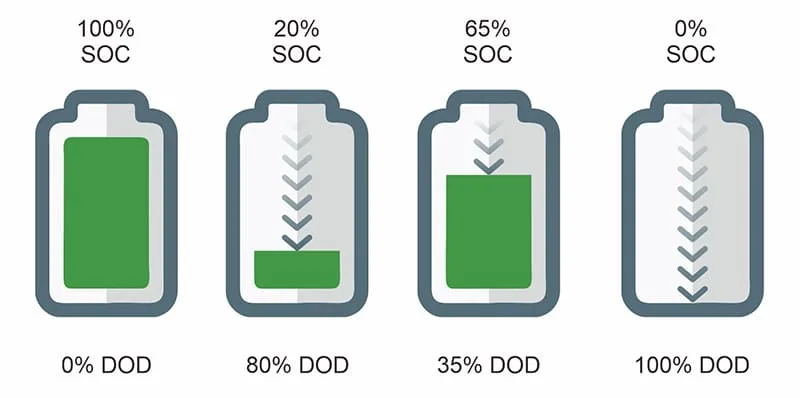
🔋 What Is Depth of Discharge (DoD)?
Głębokość rozładowania refers to the percentage of a battery’s total capacity that has been used. Na przykład, if a 100Ah battery has discharged 80Ah, jego DoD jest 80%.
💡 Formula:
Głębokość rozładowania (%) = (Energy Discharged / Total Battery Capacity) × 100
🔁 Depth of Discharge vs Cycle Life
One of the most critical relationships in battery usage is between DoD I Cykl życiowy (the number of charge-discharge cycles a battery can undergo before its capacity drops below a usable level).
📊 General Trend:
| Głębokość rozładowania | Około. Cykl życiowy (litowo-jonowy) |
|---|---|
| 100% DoD | ~500 cycles |
| 80% DoD | ~800–1,000 cycles |
| 50% DoD | ~1,200–2,000 cycles |
| 20% DoD | ~3,000+ cycles |
Kluczowy wgląd: The shallower the depth of discharge, the longer the battery lasts.

⚖️ Depth of Discharge vs State of Charge (SoC)
These two terms are often confused:
- Głębokość rozładowania (DoD): How much of the battery is used.
- State of Charge (SoC): How much charge is remaining.
They are complementary:
DoD (%) = 100 – SoC (%)
Na przykład, if your battery has 30% SoC, it has a 70% DoD.
✅ What Is 80% Głębokość rozładowania?
Jakiś 80% DoD means you have used 80% of the battery’s capacity and left 20% in reserve. For many lithium-ion batteries, operating at around 80% DoD is a common practice to balance usable capacity and cycle life.
⚙️ The 20/80 Rule for Battery Life
This widely recommended rule of thumb suggests keeping your battery charge between 20% I 80%, which means:
- Never let it fall below 20% SoC (80% DoD).
- Don’t regularly charge it to 100%.
This practice can significantly increase battery longevity, particularly in lithium-ion chemistries.
🔬 Depth of Discharge in LiFePO4 Batteries
LiFePO4 batteries are especially known for their high cycle life even at higher DoDs.
| DoD (%) | Około. Cykl życiowy (LiFePO4) |
|---|---|
| 100% | 2,000–4,000 cycles |
| 80% | 3,000–5000 cykli |
| 50% | 5,000+ cykle |
Compared to other lithium-ion chemistries, LiFePO4 offers superior stability and longevity even when discharged deeply, making it ideal for solar energy storage and off-grid applications.
📈 Why Depth of Discharge Matters
Understanding and managing DoD allows users to:
- Maximize battery life
- Optimize zwrot z inwestycji
- Prevent over-discharge damage
- Improve efektywność energetyczna in off-grid or hybrid systems
⚡ Final Thoughts
Whether you’re investing in a home solar energy system or deploying industrial-grade storage solutions, managing Depth of Discharge is key to maximizing performance and lifespan.
By keeping DoD within optimal ranges—especially with robust batteries like LiFePO4—you not only extend battery life but also protect your investment in renewable energy solutions.
Interested in high-quality LiFePO4 batteries designed for long life and high performance?
Skontaktuj się z nami już dziś to learn more about our range of advanced energy storage solutions.
10kWh akumulatory LiFePO4 10Koszty kWh baterii słonecznych w Birmie 25Systemy baterii kWh Wszystko w jednym BESS Kontener 4MWh Arabia BESS Producent Chiny Najtańsza bateria domowa Rozwiązania BESS w Chinach Hurtownia DDP w Chinach Baterie LiFePO4 z fabryki w Chinach BESS w skali chińskiej Chińscy dostawcy OEM Komercyjne magazynowanie baterii Kenia Rozwiązania DC ESS Rozwiązanie DDP bezpośrednio do DRK Skieruj Chiny do Afryki Skieruj Chiny do Afryki baterii akumulator energii Systemy magazynowania energii Globalni liderzy baterii litowych Bateria klasy A Dostawca rozwiązań do przechowywania akumulatorów w skali sieciowej Baterie domowe dla holenderskich rodzin domowe magazynowanie energii Przemysłowy BESS Kenia Kwas ołowiowy vs. Baterie litowo-jonowe LiFePO4 akumulatory LiFePO4 Baterie LiFePO4 w Republice Południowej Afryki Bateria LifePo4 Technologia baterii LifePO4 Dystrybutor LiFePO4 w Iraku LiFePO4 ESS Kenia Bateria litowo-jonowa bateria litowo-jonowa Niższe ceny Trendy rynkowe Zewnętrzna szafka chłodząca cieczą Zakup LiFePO4 w Arabii Saudyjskiej Skalowalne rozwiązania BESS dla przemysłu Panele słoneczne układ słoneczny Układanie wszystkiego w jednym Hurtownia baterii słonecznych LiFePO4 Hurtownia baterii słonecznych
4 Uwagi