
7 Zava-misy mahery vaika momba ny halalin'ny fivoahana (død) Tsy maintsy fantatrao
Halalin'ny fivoahana (død): What It Means and Why It Matters for Battery Life
When it comes to battery performance and longevity, one of the most important—yet often misunderstood—metrics is Halalin'ny fivoahana (død). Whether you’re managing a solar energy system, using lithium-ion batteries for home storage, or simply trying to maximize your battery lifespan, understanding DoD is crucial.
Ato amin'ity lahatsoratra ity, we’ll explore what DoD means, how it’s calculated, and how it directly impacts fiainana tsingerina, especially for LiFePO4 (Lithium Iron Phosphate) vatoaratra. We’ll also demystify the 20/80 rule, and clarify the difference between død SY State of Charge (SoC).
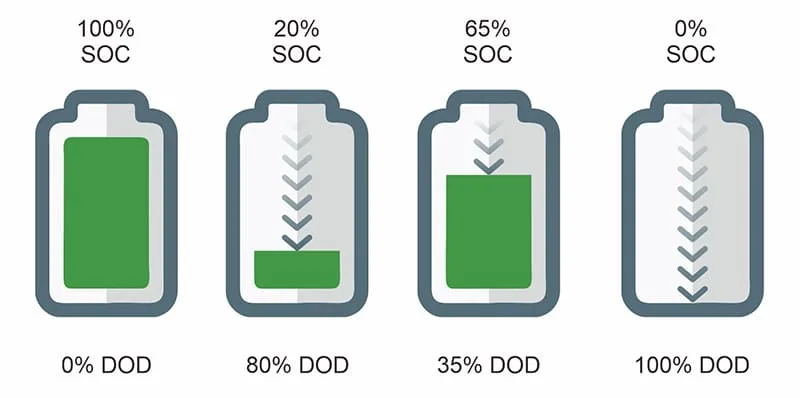
🔋 What Is Depth of Discharge (død)?
Halalin'ny fivoahana refers to the percentage of a battery’s total capacity that has been used. For example, if a 100Ah battery has discharged 80Ah, its DoD is 80%.
💡 Formula:
Halalin'ny fivoahana (%) = (Energy Discharged / Total Battery Capacity) × 100
🔁 Depth of Discharge vs Cycle Life
One of the most critical relationships in battery usage is between død SY fiainana tsingerina (the number of charge-discharge cycles a battery can undergo before its capacity drops below a usable level).
📊 General Trend:
| Halalin'ny fivoahana | Approx. Cycle Life (Li-ion) |
|---|---|
| 100% død | ~500 cycles |
| 80% død | ~800–1,000 cycles |
| 50% død | ~1,200–2,000 cycles |
| 20% død | ~3,000+ cycles |
Key Insight: The shallower the depth of discharge, the longer the battery lasts.

⚖️ Depth of Discharge vs State of Charge (SoC)
These two terms are often confused:
- Halalin'ny fivoahana (død): How much of the battery is used.
- State of Charge (SoC): How much charge is remaining.
They are complementary:
død (%) = 100 – SoC (%)
For example, if your battery has 30% SoC, it has a 70% død.
✅ What Is 80% Halalin'ny fivoahana?
An 80% død means you have used 80% of the battery’s capacity and left 20% in reserve. For many lithium-ion batteries, operating at around 80% DoD is a common practice to balance usable capacity and cycle life.
⚙️ The 20/80 Rule for Battery Life
This widely recommended rule of thumb suggests keeping your battery charge between 20% SY 80%, which means:
- Never let it fall below 20% SoC (80% død).
- Don’t regularly charge it to 100%.
This practice can significantly increase battery longevity, particularly in lithium-ion chemistries.
🔬 Depth of Discharge in LiFePO4 Batteries
LiFePO4 batteries are especially known for their high cycle life even at higher DoDs.
| død (%) | Approx. Cycle Life (LiFePO4) |
|---|---|
| 100% | 2,000–4,000 cycles |
| 80% | 3,000–5,000 cycles |
| 50% | 5,000+ BISIKLETA |
Compared to other lithium-ion chemistries, LiFePO4 offers superior stability and longevity even when discharged deeply, making it ideal for solar energy storage and off-grid applications.
📈 Why Depth of Discharge Matters
Understanding and managing DoD allows users to:
- Maximize battery life
- Optimize return on investment
- Prevent over-discharge damage
- Improve energy efficiency in off-grid or hybrid systems
⚡ Final Thoughts
Whether you’re investing in a home solar energy system or deploying industrial-grade storage solutions, managing Depth of Discharge is key to maximizing performance and lifespan.
By keeping DoD within optimal ranges—especially with robust batteries like LiFePO4—you not only extend battery life but also protect your investment in renewable energy solutions.
Interested in high-quality LiFePO4 batteries designed for long life and high performance?
Contact us today to learn more about our range of advanced energy storage solutions.
5kWh 5Batterie kWh ho an'ny trano 10Bateria kWh LiFePO4 16Vahaolana kWh LiFePO4 ho an'ny mpiara-miombon'antoka ambongadiny Rehetra-In-One BESS Container 4MWh Saudi BESS Manufacturer China Batery an-trano mora indrindra China BESS Solutions China Factory LiFePO4 Batterie China Grid-Scale BESS Fitahirizana bateria ara-barotra Kenya DC ESS Solutions DDP Solution Direct mankany DRC Alefaso any Afrika i Shina Direct China to Africa Battery Trano fanatobiana entana any ivelany any DR Congo bateria fitahirizana angovo Energy Storage Systems Bateria Grade A Mpamatsy fitehirizana bateria amin'ny sehatra Grid Batterie an-trano ho an'ny fianakaviana holandey Fitahirizana angovo an-trano Industrial BESS Kenya LiFePO4 bateria Batterie LiFePO4 any Afrika Atsimo Battery LifePo4 Mpanamboatra bateria LiFePO4 LifePO4 Battery Technology LiFePO4 ESS Kenya Battery Lithium-Ion bateria lithium ion Vidiny ambany Vidiny ambany indrindra Oganda Market Trends Batterie Solar Off-Grid ho an'ny Trano Eoropeana Kabinetra fampangatsiahana ranon-javatra ivelany Manova ny herin'ny fandraharahana miaraka amin'ny BESS azo zahana Saodiana LiFePO4 Procurement Vahaolana BESS azo zahana ho an'ny indostria Paneau solaire rafi-masoandro Manangona All-in-One Ambongadiny LiFePO4 Solar Batterie Batterie solaire ambongadiny
4 Comments