How to Calculate Solar Battery Capacity? 3 Steps to Perfect Sizing
(A Practical Guide for African Homes and Businesses, with a Focus on South Africa)
Matching Solar Battery Capacity to Load-Shedding Schedules in Africa
In regions like South Africa and other parts of Africa, frequent power outages and unreliable grid electricity make solar energy systems a lifeline for homes and businesses. A critical component of any solar setup is the battery, which stores energy for use when the sun isn’t shining. 然而, choosing the wrong battery capacity can lead to wasted money, insufficient power, or shortened battery life.
This guide breaks down the process of calculating solar battery capacity into three simple steps, tailored to Africa’s unique energy needs, climate, and solar potential.

Step 1: Determine Your Daily Energy Consumption
Before sizing your battery, you need to knowhow much energy your household or business uses daily.
- List all electrical appliances you plan to power with solar.
- Typical appliances in African households: LED灯 (5–10W), refrigerators (100–200W), TVs (50–100W), fans (50瓦), mobile chargers (10瓦), and small water pumps (200–500W).
- For businesses: Computers, 路由器, security cameras, or machinery.
- Calculate daily energy use (in watt-hours, 瓦时):
- 力量 (瓦) × Hours of use per day = Daily energy per appliance.
- Example:
- 5 LED灯 (10W each) × 6 hours = 300 瓦时
- Refrigerator (150瓦) × 24 小时 (cycles on/off) ≈ 900 瓦时
- 电视 (80瓦) × 4 hours = 320 瓦时
- Total daily energy = 300 + 900 + 320 = 1,520 瓦时 (1.52 千瓦时)
- Factor in inefficiencies:
- Solar systems lose energy due to inverter inefficiency (~10–20%) and battery charging/discharging losses (~10–15%).
- Multiply total daily energy by1.3 (30% buffer):
- 1.52 kWh × 1.3 = ~2 kWh per day.
Step 2: Calculate Battery Capacity Based on Autonomy Days
Battery capacity depends onhow many days you need backup power (autonomy days). In South Africa, where load-shedding is common, 2–3 days of autonomy is practical.
1.Formula:
电池容量(千瓦时)=Daily Energy(千瓦时)×Autonomy Days
- Example: For 2 days of autonomy:
2 kWh/day×2 days=4 kWh
2.Convert kWh to Amp-Hours (啊):
- Batteries are rated in Ah at a specific voltage (例如, 12V, 24V, 48V).
- Formula:

- Example: For a 48V system:

3.Factor in Depth of Discharge (国防部):
- Most batteries (例如, lithium-ion) should not discharge below 80–90% DoD. Lead-acid batteries are limited to 50% 国防部.
- Adjust capacity:

- Example: For lithium-ion (90% 国防部):

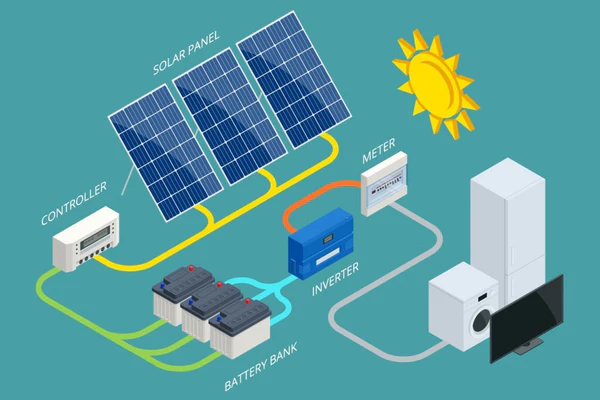
Step 3: Match Battery Capacity to Solar Panel Output
Your battery must align with your solar panel array’s charging capability.
- Check daily solar generation:
- South Africa averages4–6 peak sun hours daily (varies by season).
- Formula:Solar Panel Output(瓦时)=Panel Wattage×Sun HoursSolar Panel Output(瓦时)=Panel Wattage×Sun Hours
- Example: 400W panels × 5 sun hours = 2,000 瓦时 (2 千瓦时).
- Ensure panels can recharge the battery:
- Daily solar generation should exceed daily energy use.
- Example: If you use 2 kWh/day and generate 2 kWh/day, you’ll need extra capacity for cloudy days.
- Account for system expansion:
- Add 20–30% extra battery capacity for future needs (例如, adding appliances).
Key Considerations for African Users
- 电池类型:
- Lithium-ion: Longer lifespan (10+ 年), higher DoD (90%), but costly.
- Lead-acid: Cheaper but shorter lifespan (3–5 年) and lower DoD (50%).
- 温度:
- High temperatures (common in Africa) reduce battery efficiency. Install batteries in shaded, ventilated areas.
- 本地支持:
- Choose brands with service centers in your region (例如, Huawei, Victron Energy, or local suppliers).
Example Calculation for a South African Household
- Appliances: 10 灯 (100W total), 冰箱 (150瓦), 电视 (80瓦), fan (50瓦).
- Daily energy: 1.5 千瓦时 + 30% buffer = 1.95 千瓦时.
- Autonomy: 2 days → 3.9 千瓦时.
- Battery voltage: 48V → 3.9 kWh × 1,000 / 48V = 81.25 啊.
- Lithium-ion (90% 国防部): 81.25 啊 / 0.9 ≈ 90 啊.
- Recommended battery: 100 Ah lithium-ion (48V).
Final Tips
- Use a solar calculator tool for precision.
- Consult local installers to validate your design.
- Prioritize energy-efficient appliances to reduce battery size and cost.
By following these steps, you’ll ensure your solar battery system meets your needs, survives load-shedding, and withstands Africa’s climate. 🌞🔋
Further Reading:
- [The Ultimate Guide to 48V 100Ah Lithium Battery Wall Mounted: Answering 5 Key FAQs]
- [48V 200Ah Solar Battery Uganda: Solve Outages & Save Costs]
5千瓦时 5kWh 家用备用电池 10千瓦时磷酸铁锂电池 16面向批发合作伙伴的 kWh LiFePO4 解决方案 多合一 BESS集装箱4MWh沙特 BESS制造商中国 最便宜的家用电池 中国BESS解决方案 中国工厂磷酸铁锂电池 中国电网级电池储能系统 肯尼亚商业电池存储 直流储能系统解决方案 直接发往 DRC 的 DDP 解决方案 中国直飞非洲 中国直飞非洲电池 刚果民主共和国海外仓 储能电池 储能系统 A级电池 电网规模电池存储供应商 荷兰家庭的家用电池 家庭储能 工业 BESS 肯尼亚 磷酸铁锂电池 南非的磷酸铁锂电池 LifePo4电池 磷酸铁锂电池制造商 LifePO4电池技术 LiFePO4 ESS 肯尼亚 锂离子电池 锂离子电池 更低的价格 最低价格 乌干达 市场趋势 欧洲家庭离网太阳能电池 室外液冷柜 通过可定制的 BESS 彻底改变业务能力 沙特磷酸铁锂采购 适用于工业的可扩展 BESS 解决方案 太阳能板 太阳系 堆叠一体式 批发磷酸铁锂太阳能电池 批发太阳能电池



一条评论